 CARE ASSISTANT
 NL
NLNonwovens: hydrophilic in front, hydrophobic around
A nonwoven is a web of fibres bonded without weaving. Depending on its treatment it lets liquid through or stops it. A protection uses several, each in its place.
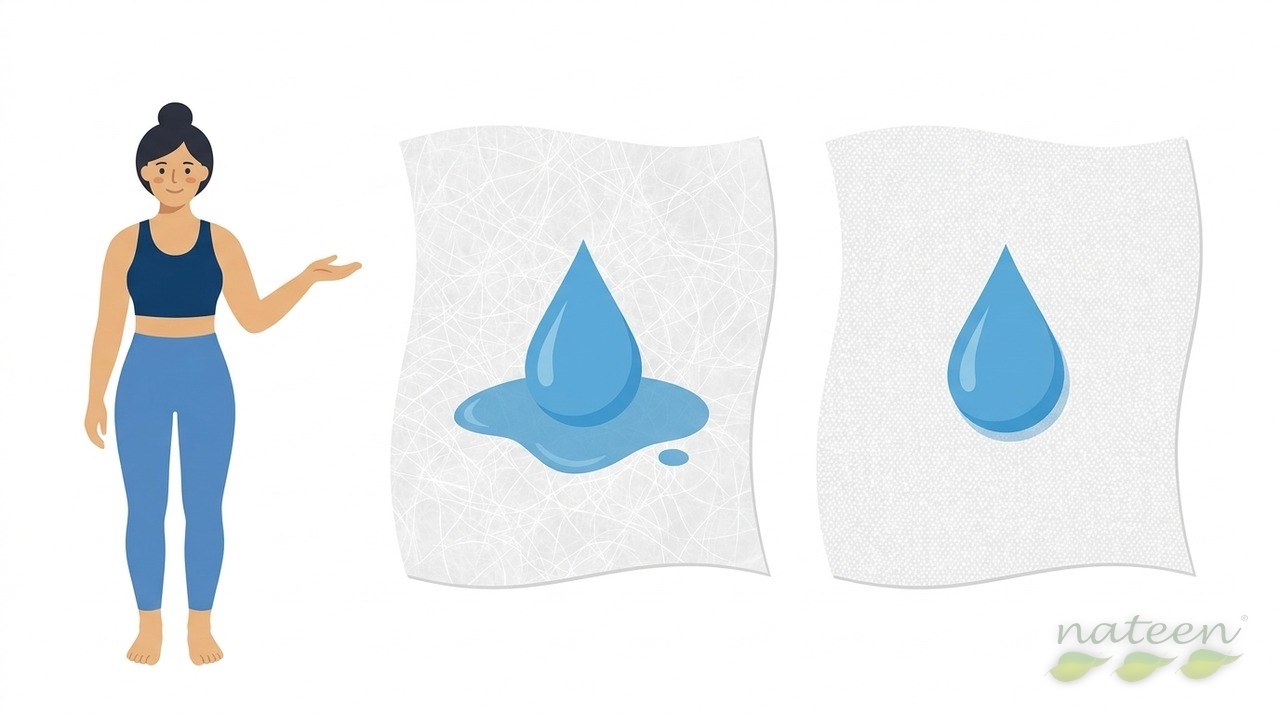
The top sheet, hydrophilic
The layer against the skin is a polypropylene nonwoven treated to be hydrophilic: liquid passes through it in a second instead of sitting on the surface. Its softness and basis weight are chosen for comfort, its permeability for speed.
Barriers and ears, hydrophobic
Around the core, the leak barriers and side panels are hydrophobic nonwovens: liquid beads on them and stays in the absorbent zone. On our products this hydrophobic web is deliberately narrower than the product; the central strip remains hydrophilic, and that is where the liquid enters.
On ranges with a partial cloth-like back, the ears are hydrophobic nonwoven alone, without film, to stay light and breathable where there is nothing to hold.
Spunbond, SMS, basis weight
Spunbond gives a regular, strong web; SMS, a sandwich of spunbond and meltblown, adds a finer barrier to liquids. Basis weight is counted in grams per square metre: the higher it is, the more covering the web, but the stiffer. We set each nonwoven at the minimum useful for its function.
Soft, fast hydrophilic top sheet, hydrophobic nonwoven barriers and ears, basis weights set function by function, bought from qualified suppliers on both sides of the Atlantic.
- Hydrophilic where liquid enters, hydrophobic where it must not go.
- The hydrophobic web is narrower than the product, on purpose.
- Higher basis weight does not mean better.
These pages describe materials and test methods in general terms. The exact characteristics of each product are on its technical sheet; they evolve with our laboratory work.